
Skin
GHK-Cu for Skin: Benefits, Collagen, Fine Lines & Hair Research
12 October 2026 · 9 min read · Zenosha Research Team
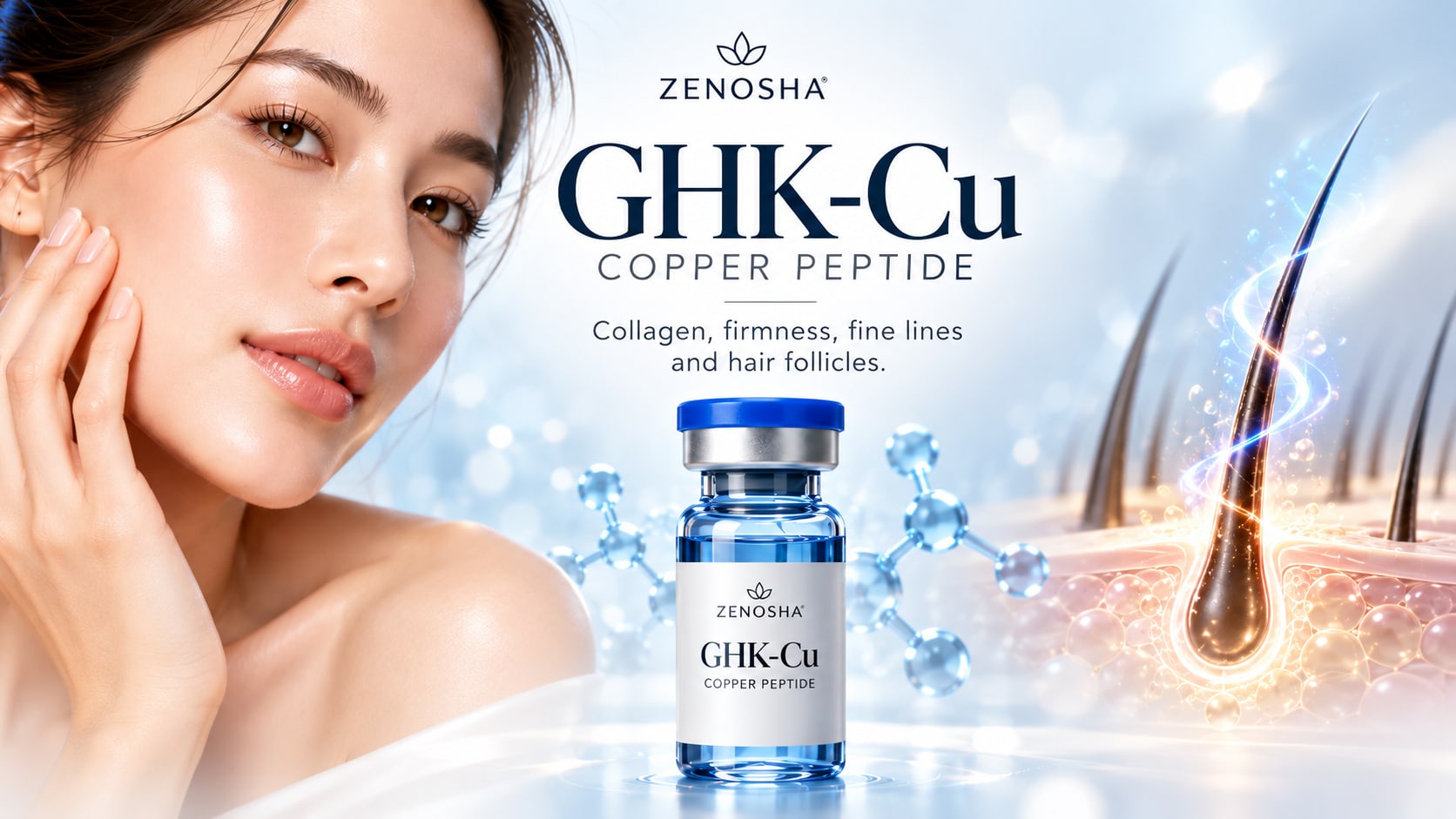
GHK-Cu, also known as a copper peptide, has attracted growing interest in skincare and skin biology research, particularly in relation to collagen, skin firmness, fine lines, visible texture and hair follicle signaling.
The ingredient combines the naturally occurring tripeptide GHK with copper. Researchers have explored its relationship with extracellular matrix remodeling and tissue repair mechanisms, making it an interesting subject in cosmetic science.
What Is GHK-Cu?
GHK-Cu is a copper-binding tripeptide composed of three amino acids: glycine, histidine and lysine.
In cosmetic ingredient lists, it is commonly identified as Copper Tripeptide-1.
Scientific research has investigated GHK-Cu in relation to several processes:
- Fibroblast activity and skin structural support
- Collagen synthesis and remodeling
- Extracellular matrix regulation
- Tissue repair and renewal signaling
- Biological signaling around hair follicles
These mechanisms explain why copper peptides have become a topic of interest in skincare research.
However, experimental findings do not automatically establish visible benefits from every product containing this ingredient.
1. GHK-Cu Benefits for Collagen and Skin Firmness
Collagen provides essential structural support to the skin, while elastin contributes to elasticity and resilience.
GHK-Cu has been investigated for its interactions with fibroblasts and extracellular matrix components.
A published 2015 scientific review describes GHK-related pathways involved in collagen turnover and tissue remodeling.
These findings help explain why copper peptides are frequently discussed in the context of skin firmness, elasticity and visible texture.
The most useful questions for evaluating a finished cosmetic product are whether it has been tested in humans and whether improvements in firmness or appearance were actually measured.
Laboratory findings alone should not be treated as a guarantee of visible results.
2. GHK-Cu for Fine Lines and Skin Texture
Another major area of interest is the relationship between GHK-Cu and age-related changes in skin appearance.
Some cosmetic research has reported changes in wrinkles, skin density and visible signs of photodamage with particular formulations containing GHK-related ingredients.
When reviewing these studies, it is important to consider:
- Whether the study was conducted in humans
- Which specific ingredient and formulation were tested
- How fine lines or skin texture were measured
- Whether other active ingredients were included
- How long the evaluation period lasted
This evidence helps explain the ingredient's popularity in anti-aging research.
However, these observations should not be interpreted as proof that GHK-Cu reverses aging or eliminates wrinkles in every formulation.
3. GHK-Cu and Skin Renewal Research
GHK-Cu has also been studied in tissue remodeling and repair-related biological processes.
Researchers have explored its relationship with extracellular matrix remodeling, cellular signaling and pathways associated with oxidative balance and inflammation.
These mechanisms are relevant to understanding how skin and surrounding tissue maintain and renew their structure.
It is important to distinguish tissue-repair experiments from cosmetic studies involving visible skin appearance.
Research involving wound healing does not automatically demonstrate that a cosmetic product can treat wounds or skin diseases.
4. GHK-Cu and Hair Follicle Research
GHK-Cu is also discussed in connection with hair follicle biology and scalp research.
Scientists are interested in signaling processes involving the cells and tissues surrounding hair follicles.
Areas of research interest include:
- The biological environment around hair follicles
- Cellular signaling related to follicle function
- Scalp tissue structure
- Interactions between tissue remodeling and follicle biology
These mechanisms are scientifically interesting, but they do not establish that every GHK-Cu product stimulates new hair growth.
Human trials measuring outcomes such as hair density and hair count would be necessary to support specific regrowth claims.
5. GHK-Cu vs GLOW vs KLOW Peptide Blends
People researching GHK-Cu may encounter commercial blend names such as GLOW and KLOW.
These names are used by some suppliers for combinations of multiple research peptides.
Examples of formulations marketed under these names may include:
- GHK-Cu as an individual peptide
- GLOW: GHK-Cu, BPC-157 and TB-500
- KLOW: GHK-Cu, BPC-157, TB-500 and KPV
GLOW and KLOW are not standardized chemical names, and their ingredients and quantities can vary between suppliers.
The components may be studied in different biological pathways, but combining several peptides does not automatically establish greater effectiveness or safety.
The actual formulation and supporting evidence should always be assessed individually.
6. GHK-Cu Research Vials vs Cosmetic Serums
GHK-Cu can appear in different product formats, but these formats should not be considered interchangeable.
A research vial labeled 50 mg refers to the quantity of the research material.
It does not identify an established facial concentration or provide validated skincare instructions.
A professionally formulated cosmetic serum must be evaluated based on its full composition, stability, concentration and delivery properties.
Likewise, evidence involving topical cosmetic formulations should not be automatically applied to injectable, nasal or other routes of administration.
Research materials and cosmetic products have different intended purposes and should be assessed separately.
7. How Does GHK-Cu Work?
The GHK peptide consists of glycine, histidine and lysine.
When GHK binds with copper, it forms the GHK-Cu complex.
The copper-binding characteristics of the molecule are relevant to its chemical properties and biological behavior.
Scientific research has examined how GHK-related compounds interact with pathways involved in cellular activity and extracellular matrix regulation.
The actual behavior of a finished skincare formula also depends on stability, delivery and other formulation characteristics.
Not all ingredients described as copper peptides are necessarily identical.
8. What Does Published GHK-Cu Research Show?
A scientific review published in 2015 examined multiple cellular pathways associated with GHK and skin regeneration.
Additional scientific literature has explored skin penetration, cosmetic formulations and potential anti-wrinkle applications.
These publications help explain why GHK-Cu continues to attract interest in cosmetic science.
However, evidence should be evaluated according to the study design.
Laboratory experiments, animal studies, small cosmetic trials and well-controlled human trials provide different levels of evidence.
Benefits observed with one formulation should not automatically be attributed to every product containing GHK-Cu.
9. GHK-Cu vs Hyaluronic Acid vs Retinol
GHK-Cu, hyaluronic acid and retinol are frequently discussed in skincare, but they have different research backgrounds.
GHK-Cu: Investigated for its relationship with cellular signaling, collagen biology and extracellular matrix remodeling.
Hyaluronic Acid: Widely used in cosmetic formulations for hydration and improvements in the visible appearance and feel of skin.
Retinol and Retinoids: Have a longer history of clinical investigation in photoaging and the appearance of fine lines and wrinkles.
These ingredients should not be treated as direct substitutes.
Their relevance depends on the formulation, desired cosmetic outcome and available clinical evidence.
10. Final Thoughts: Why GHK-Cu Matters in Skin Research
GHK-Cu is a copper-binding peptide studied in connection with collagen, skin firmness, fine lines, tissue remodeling and the biological environment surrounding hair follicles.
Its scientific interest comes from the variety of biological pathways being investigated.
At the same time, laboratory mechanisms and the visible performance of finished cosmetic products are not interchangeable forms of evidence.
Anyone researching peptide ingredients should consider the exact compound, study quality, formulation and intended use.
For more background on peptide science, read our introductory guide: What Are Peptides? A Practical Beginner's Guide.
Scientific References
- GHK Peptide as a Natural Modulator of Multiple Cellular Pathways in Skin Regeneration — PubMed
- Additional GHK-Cu research — PubMed
- Additional scientific literature — PubMed
This article is provided for scientific education and does not constitute medical advice or a guarantee of performance for any particular product.
Frequently asked questions
- What are the potential skin benefits of GHK-Cu?
- GHK-Cu has been studied in relation to collagen signaling, skin firmness, fine lines and tissue remodeling. Visible cosmetic outcomes depend on the specific formulation and clinical evidence.
- Is Copper Tripeptide-1 the same as GHK-Cu?
- Copper Tripeptide-1 is the cosmetic ingredient name commonly used for the GHK-copper complex. Always check the exact ingredient and formulation.
- Does GHK-Cu promote hair growth?
- GHK-Cu is discussed in hair follicle and scalp biology research, but this does not prove that every GHK-Cu product causes new hair growth. Product-specific human trials are needed to support regrowth claims.